Interactive Interest
Cover image for Unpredictably predictable
NEW

Unpredictably predictable

The best creative is unpredictably predictable,

that is to say, customers should know exactly how you might do something,

but have no level of certainty as to what you might do.

Constantly predictable and you’re unengaging.

Constantly unpredictable and you’re unfamiliar.

This means that your output should adhere to certain standards and truths.

While constantly challenging expectations and leveraging with new formats to stretch it’s boundaries.

If unpredictably predictable is the balance then it’s much easier to assess where you should focus your time.

If you’re a startup that is relatively unfamiliar, establishing a level of predictability is your goal, encouraging customers to form a somewhat consistent identity around your product.

Whilst if you are a large incumbent that hasn’t reinvented in years, then unpredictably might just be what is required to restore balance.

That’s the fine ratio.

We want to be constant enough to be immediately recognisable,

Yet different enough to be immediately shareable.

The fallacy of brand loyalty

People talk about brand loyalty like it’s a marital affair, when actually the relationship is 100% contractual. A contract which says ‘if you continue to do x for me well, then I will continue to buy from you.’

‘If you continue to make shoes that are comfortable yet sustainable, I will continue to buy form you.’

‘If your product continues to help us create faster, then my team will continue to use it.’

‘If you continue to offer good things to watch, then I won’t terminate my subscription.’

X can be anything. From providing a positive feeling, to efficiently and performance. It's a promise you tell your customers about what your service will do for them and/or how you will deliver it.

The danger of seeing this relationship as more than contractual is that companies gain a false sense of security and believe customers will continue to engage with them despite of x. Not the case!

The 4 factors almost every enterprise considers before approving software

Enterprise companies are often large, quite slow, and messy. Which means that the buying process for enterprise software is often large, quite slow, and messy. This process is vastly different to the world of B2C because rather than selling your product to just one individual, you’re selling it to an individual, who’s part of a team, that is part of an organisation with hundreds of people. This means more conversations, more layers, and more stakeholders. Despite this, there is a lot you can do as a seller to anticipate and streamline the buying process – increasing the chances that a business will choose you over your comparators.

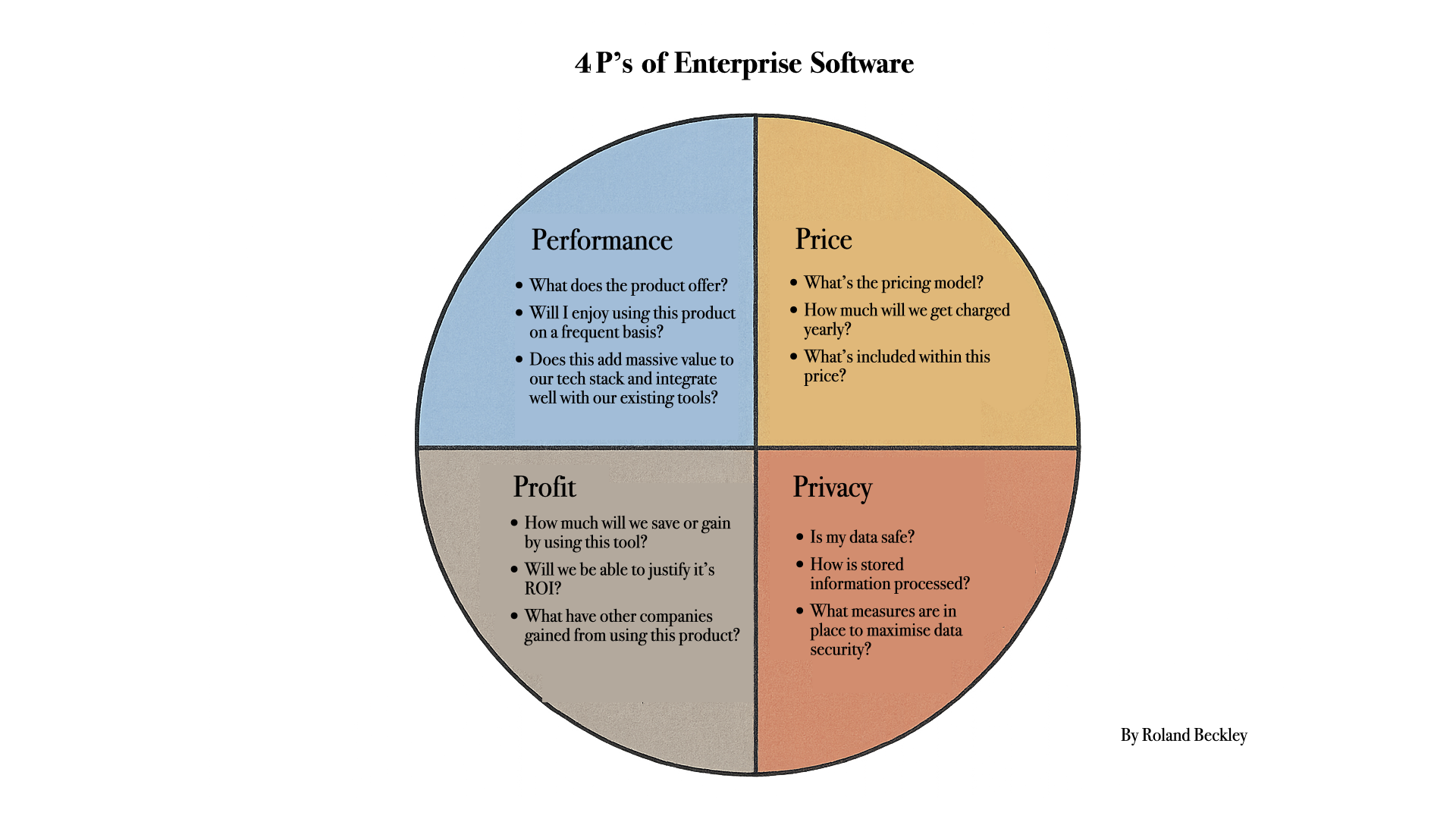
From being on both the buyer and seller side of enterprise software I’ve discovered that what seems like a lot to consider can actually effectively be broken down into 4 main elements that businesses typically look for when comparing solutions to find the right fit. These are the 4 elements you want to address on your website, elevate in your marketing, and continue to test messaging around to ensure you have the most effective narrative. They are the 4Ps of enterprise software:

Performance, Price, Profit, and Privacy.

The 4Ps of enterprise software

Performance simply speaks to how well your product works. What features are included, what benefits do they offer, how well it is designed, whether it feel like something you’d enjoy using. Part of assessing performance is also discovering how well the product works in tandem with other tools within the companies existing stack – ensuring your tool is effectively adding value to the whole ecosystem and not just operating in a silo.

Price is self-explanatory too. This addresses a focus on your business model, how much the software costs, and how these costs are broken down over time.

Profit is all about ROI and the extent to which this product will cause a saving and/or improve a process. Whether that be saving time, saving cost, improving capabilities etc. Within this prospects are also interested to see how other customers have benefited from your solution. So this is where customer stories, testimonials, and showcases come into play.

Last but by certainly no means least is privacy. This is an aspect often overlooked but is becoming an increasing more important part of the procurement process for Enterprises. Centre of attention is the question ‘How safe is my data?’ Customers want to know you’re a trustworthy partner and expect to see information about how their data is stored and processed. Now more than ever, with the rise of many tools being built entirely on AI, customers are adding an extra layer of scrutiny in this area to ensure their data is not being used for training models or sold to third-party organisations without authorisation.

The whole process tends to go something like this: In the first stage, it’s often your ICP (ideal customer profile) or someone near enough to it that discovers and evaluates your solution, primarily focusing on performance and profit as they determine whether this could solve their problem. Next, this champion might request a demo to learn more and share findings with their team or manager, where performance, profit, and price become the core evaluation criteria, often in that order of importance. If all goes well and the team are keen, the third stage involves organisational approval from multiple stakeholders who each scrutinise different aspects of the offering. Finance examines price and budget alignment, security teams evaluate privacy and compliance measures, whilst legal reviews contract terms and risk factors. Another level of approval to consider here is C-suite. Whether early in the buying process or later, CEO’s are now being actively more involved in the procurement process – scrutinising products and ensuring that the tech suite across the company is more consolidated and streamlined.

How you address these 4 main elements and the channels you use to communicate your value in each one is up to you, but ensuring you’re aware of these factors and constantly improving your messaging around them is vital to increase your likelihood of appeasing all stakeholders throughout the buying process. The framework's power lies in its predictability – by systematically addressing these apprehensions before they even arise, you can better anticipate objections, prepare targeted responses, and guide prospects through their buying journey more effectively than any other comparator they may be considering.

The untapped appeal of software gifting

Why don’t companies allow customers to gift software?

Today, B2C software is more personal than ever before. People are using some of these tools on a daily basis to earn, learn, create, plan, and play. So why is there no option for them to be gifted?

For some reason referral programs have become common practice and one of the optimal ways of boosting advocacy. But I’d argue that a gift goes a step further because they’re more useful in multiple situations. Picture this:

It could be the mentor who offers a 12-month Figma pro subscription as a gift to their mentee that is just getting started with product design. Or the friend who buys a 12-month Notion subscription for another friend that is starting out with freelancing and enjoys planning. Or the event host who offers a 12-month Cursor subscription as a prize to one of the guests in attendance. The list goes on. Each a much welcomed gifting option that shows you’ve considered the interests or even aspirations of the receiver.

This isn’t a new concept. When I was growing up, Apple gift cards were highly appreciated gifts because it meant that you could use those credits to add something personal and useful to your device, be it an app or song. Fast forward to today and Apple are still investing in gift cards – going beyond the previous realm of apps and songs and into being able to use your credits to buy anything on the Apple Store.

Whether this manifests physically as a small beautifully packaged gift or digitally as an interactive experience, that’s up to you and your finance team. But the returns are huge either way:

  • Upfront cash for lengthy subscriptions.
  • Potential of establishing or re-establishing a relationship with a user, who after the gifted subscription ends, is more likely to go onto purchasing a subscription themselves.
  • A new expressive channel to bring your brand identity to life in a human yet creatively exciting way.

The third point highlights another important aspect of this strategy which is to own your own experience if feasible. Your own storytelling, design, and aesthetic. I’d avoid using a 3rd party gift card marketplace because the utility isn’t the only thing people are buying, but also the experience and feeling it offers.

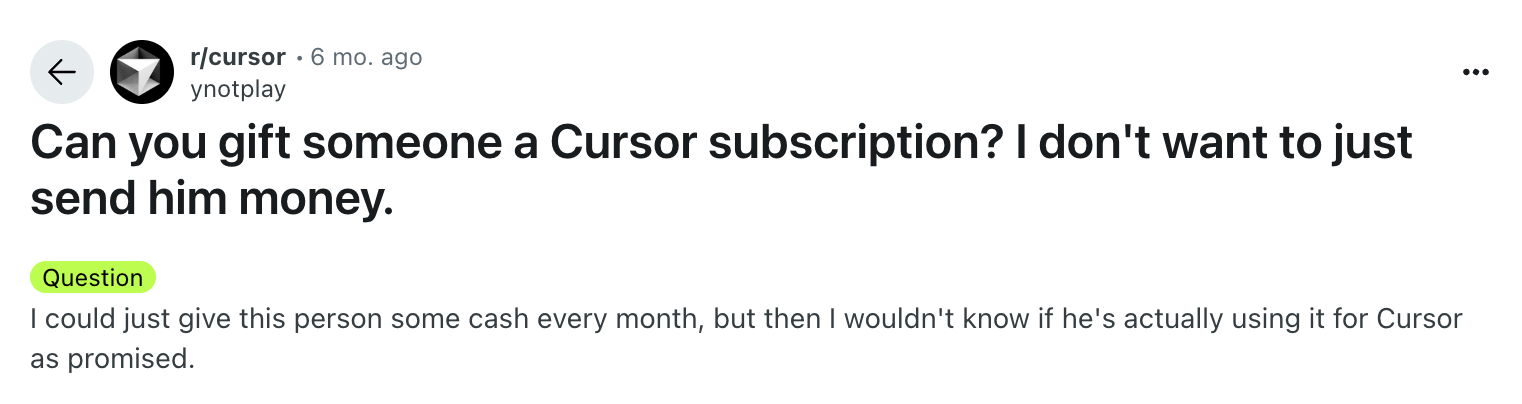
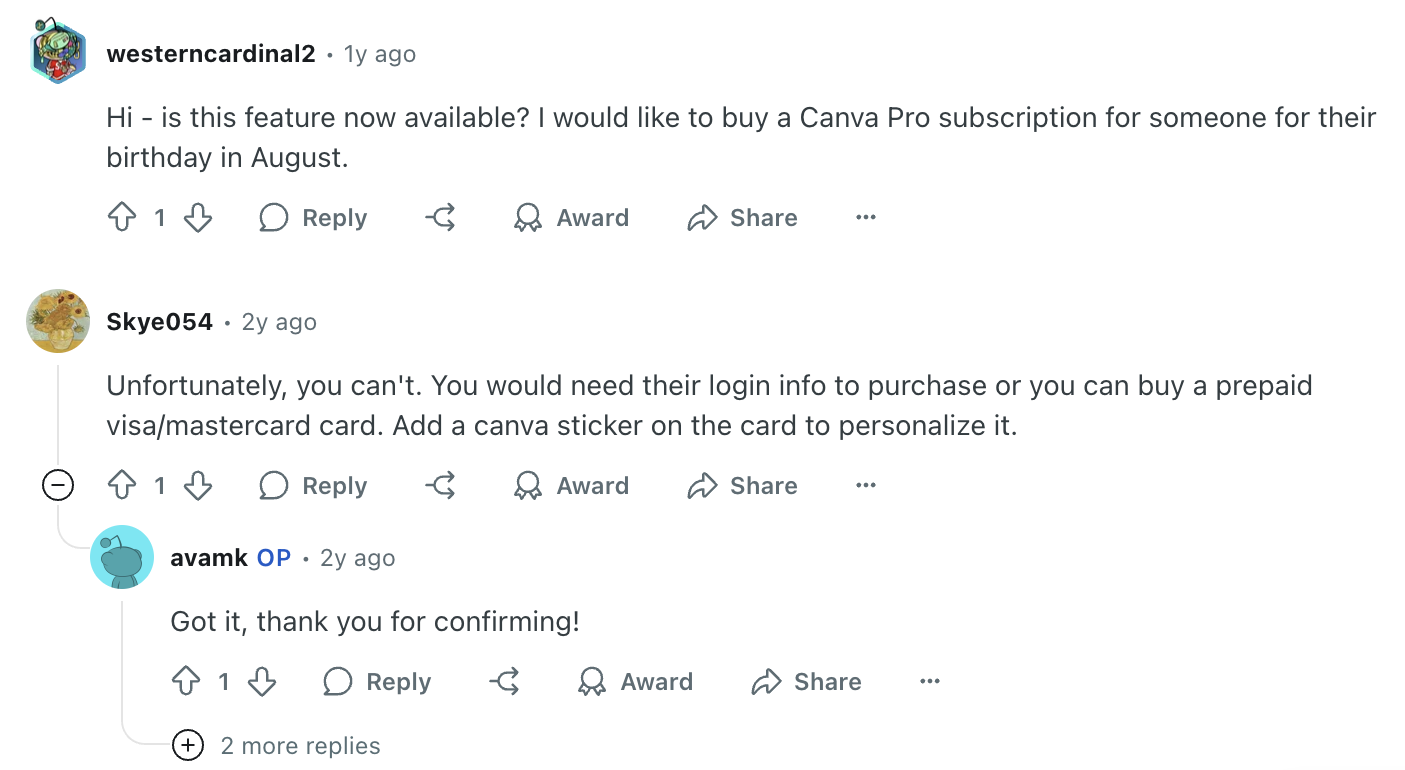
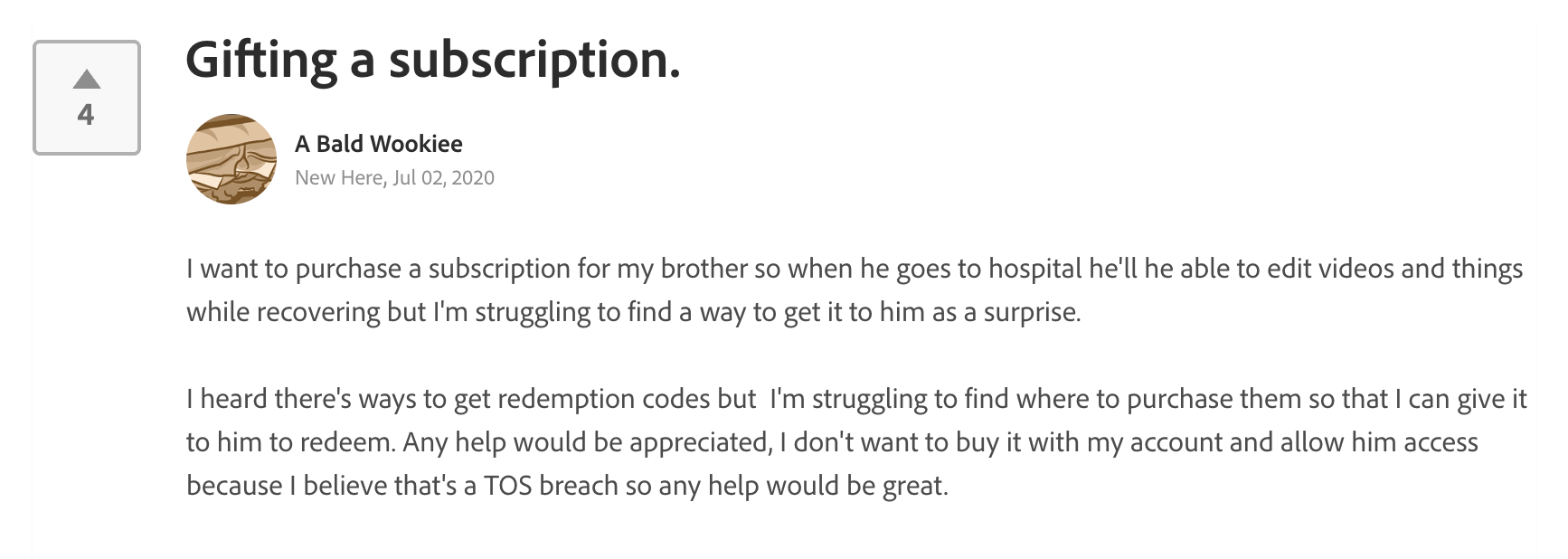
Don’t believe this is something people actually would utilise? 10 minutes of searching online will tell you otherwise:

Software gifting search resultsSoftware gifting search resultsSoftware gifting search resultsSoftware gifting search results

The Simple Act

The simple songs are recalled the most.

The simple ads connect with the most people.

The simple products have the most users.

Simple is not boring.

Simple is considered.

Simple is timeless.

Simple is universal.

Simple is accessible.

Simple is void of clutter.

Simple speaks for itself.

Some people think simple is less, but it’s actually more:

More thought.

More hours.

More care.

More revisions.

An experience void of simplicity is noise.

Noise is easy to make; whereas simplicity is more challenging to maintain.

But those that maintain it cut through,

and often silence their noisy counterparts.

Companion Planting

Companion planting is a term often used in gardening.

It refers to the act of sowing certain types of plants in close proximity, so they may benefit from each other's unique offering, and thus grow sustainably. Giving and receiving in tandem.

An example of this is the ‘3 sisters’: corn, bean, and squash plants. When planted close together:

  • Corn offers a physical support structure
  • Beans provide nitrogen
  • Squash covers the soil to prevent evaporation and weed competition

Ecosystems thrive when plants collaborate rather than compete.

And this is not dissimilar to the dynamics of a brilliant team or community.

Everyone has something to give. Therefore, give, and provide the platform for others to do the same.

Speaking to Customers

When was the last time you met with your customers face to face?

Not learning about them through a trend report, or analysing their usage behind a screen.

But hearing them share their experiences in first person, noticing the micro-interactions displayed as they use your product, seeing the emotion expressed as they explore the journey that you crafted.

Most of us may have seen the recent articles about Airbnb’s growth since shifting to a model focused on brand building. But beyond campaigns and design refreshes. This approach was fuelled by the fact that they maintained close contact with their community through a willingness to meet and hear from the individuals that form it.

In a world where everyone wants to be heard, positioning yourself as the brand that listens becomes a key distinguishing attribute.

Regenerative Business

Is your business regenerative?

The definition of regeneration is to regrow (new tissue) after loss or damage.

It’s a great attribute to have.

One that signals a sense of longevity, sustainability, and resilience.

For this to happen on a regular basis, there must be a process in place to facilitate it.

There must be an intent to nurture the new

And a willingness to recognise its importance to the future.

So ask yourself:

Does my business act as fertile ground for growth?

Is my business set up to undergo renewal, should it be necessary?

Are we doing enough today to develop our tomorrow?

The 8 Star Experience

A 5 star experience is the expectation.

That just means the product you made performed as it should.

How many times have you given an Uber driver 5 stars for simply picking you on time and dropping you off at your destination?

The transition from a good experience to an exceptional one starts when you begin to consider what a 6,7, and 8 star offering looks like.

That should be the bar, or rather the platform.

Ultimately this takes patience.

It takes empathy.

It takes a willingness to dig a little deeper, go a little further.

Something not every brand is willing to do.

Doing digital vs being digital

Many companies do digital, few are actually digital-first organisations; despite the claims.

To be digitally-led is to see technology as a key driver in achieving your strategic aspirations. Developing products that leverage it's capabilities to deliver incremental impact for customers, long-term.

It is to constantly operate in beta mode – fostering a culture of learning that permeates throughout the business.

And to ensure cross-functional connections are seamless, with each part of the business maintaining an appreciation for the opportunities offered by technology.

Ultimately, operating as a digital organisation shouldn't be an initiative solely governed by the CTO or CDO. It’s an ambition that should be shared throughout the whole company, and shape every decision that you make.

People and Spaces

For most brands, a new store is simply another touch-point.

But for those that live in the area, it’s much more.

The most impactful retail locations put the life that surrounds the building before it’s infrastructure,

positions the brand as an extender of the local culture already fostered,

and goes beyond procurement to provide a hub that gives more to the community than it takes.

“First life, then spaces, then buildings…” – Jan Gehl (Danish Architect)

Customer Service

The Genius Bar isn’t just a nice to have for Apple, it’s an integral part of their brand experience that says to the customer “we hear you, and we care”. It mitigates the risk of purchase and fuels customer satisfaction.

Often, we attribute the affinity for companies like Apple and Nike to the great work they do pre-purchase. But don’t always speak about the positives of their post-purchase experience. For most brands the service is great, until you have a query, until your product acquires a fault, until you have to make a return. Then you begin to see how much they really value customers, or rather how much they don’t.

Efficiency and Direction

The prerequisite for efficiency is direction. Hence why strategy is so important.

Once you have a plan in place you can run with conviction;

reassured in the fact that you're competing in the right race.

What to do and what not to

A key element of being efficient is minimising waste.

This is often overlooked.

Though it is important to highlight what you should do.

It is just as pivotal to identify what not to do and what to stop doing.

Clear the road, make room for what matters, and avoid unnecessary pivots.

What's our why?

“Hold the problem you’re solving tightly, hold the user tightly, hold the solution you’re building loosely” – Michael Seibel

Building for a fleeting 'why' is like aiming at a moving target.

What [we’re building] and how [we build it] is subject to change, it’s inevitable.

But why we’re doing it shouldn’t.

That’s what we’re solving.

That’s our North Star.

If we agree that the why should remain consistent, ensuring that it feels right to start with becomes all the more important.